
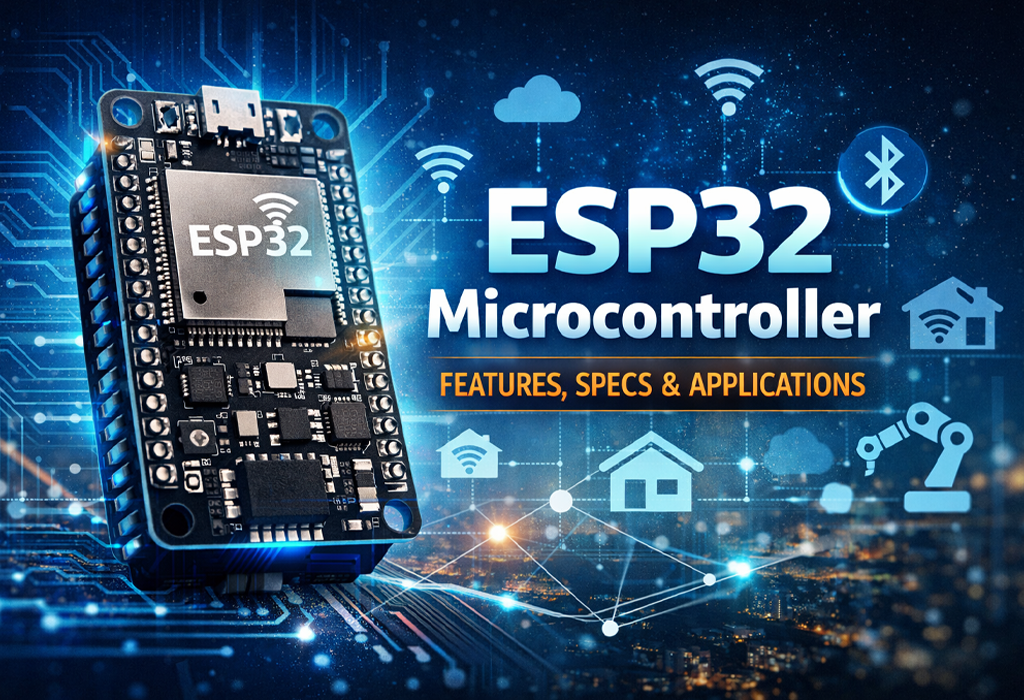
ESP32 Microcontroller: Features, Specifications, and Applications
The ESP32 microcontroller has become one of the most popular development boards for IoT and embedded system projects. With built-in WiFi and Bluetooth connectivity, powerful processing capabilities, and low cost, the ESP32 is widely used by developers, hobbyists, and engineers around the world.
In this article, we will explore what the ESP32 is, its main features, and why it is considered one of the best microcontrollers for modern electronics projects.
What is ESP32?
The ESP32 microcontroller is a low-power system-on-chip (SoC) designed for IoT applications. It integrates WiFi and Bluetooth connectivity, making it ideal for smart devices, home automation systems, and wireless sensors.
The chip was developed by Espressif Systems, a company known for producing affordable and powerful wireless microcontrollers.
The ESP32 is the successor of the popular ESP8266, offering more processing power, better connectivity, and additional hardware features.
Key Features of ESP32
The ESP32 includes many advanced features that make it suitable for a wide range of applications.
Built-in WiFi and Bluetooth
One of the biggest advantages of ESP32 is its integrated wireless connectivity. It supports:
- 2.4 GHz WiFi
- Bluetooth Classic
- Bluetooth Low Energy (BLE)
This allows devices to communicate easily with smartphones, servers, and other IoT devices.
Powerful Dual-Core Processor
ESP32 uses a dual-core processor that can run up to 240 MHz, making it significantly faster than many other microcontrollers.
Low Power Consumption
The chip includes multiple power-saving modes, allowing it to operate efficiently in battery-powered IoT devices.
Multiple GPIO Pins
ESP32 offers a large number of GPIO pins that support various interfaces such as:
- SPI
- I2C
- UART
- PWM
- ADC
This makes it flexible for connecting sensors, displays, motors, and other electronic components.
Common Applications of ESP32
Because of its versatility, the ESP32 microcontroller is used in many different projects.
IoT Devices
ESP32 is widely used in Internet of Things systems such as smart home automation, connected appliances, and environmental monitoring devices.
Smart Home Systems
Developers use ESP32 to build smart switches, lighting control systems, and security devices.
Wireless Sensors
ESP32 can collect sensor data and transmit it to cloud platforms or mobile applications.
Robotics and Automation
Its processing power and connectivity make it suitable for robotics projects and automation systems.
ESP32 vs Arduino
Many beginners compare ESP32 with traditional Arduino boards.
Feature | ESP32 | Arduino Uno |
WiFi | Built-in | Not built-in |
Bluetooth | Yes | No |
Processor Speed | Up to 240 MHz | 16 MHz |
GPIO Pins | More | Limited |
Because of these features, ESP32 is often preferred for modern IoT applications.
Why ESP32 is Popular
There are several reasons why ESP32 has gained massive popularity among developers:
- Low cost and easy availability
- Built-in wireless connectivity
- Strong community support
- Compatibility with multiple development environments
Many developers program ESP32 using the Arduino IDE, which makes development simple even for beginners.
Conclusion
The ESP32 microcontroller is a powerful and versatile platform for IoT and embedded systems. With integrated WiFi, Bluetooth, high processing power, and flexible hardware interfaces, it enables developers to build innovative connected devices.
Whether you are a beginner learning electronics or an engineer designing smart products, the ESP32 offers a reliable and affordable solution for modern technology projects.
